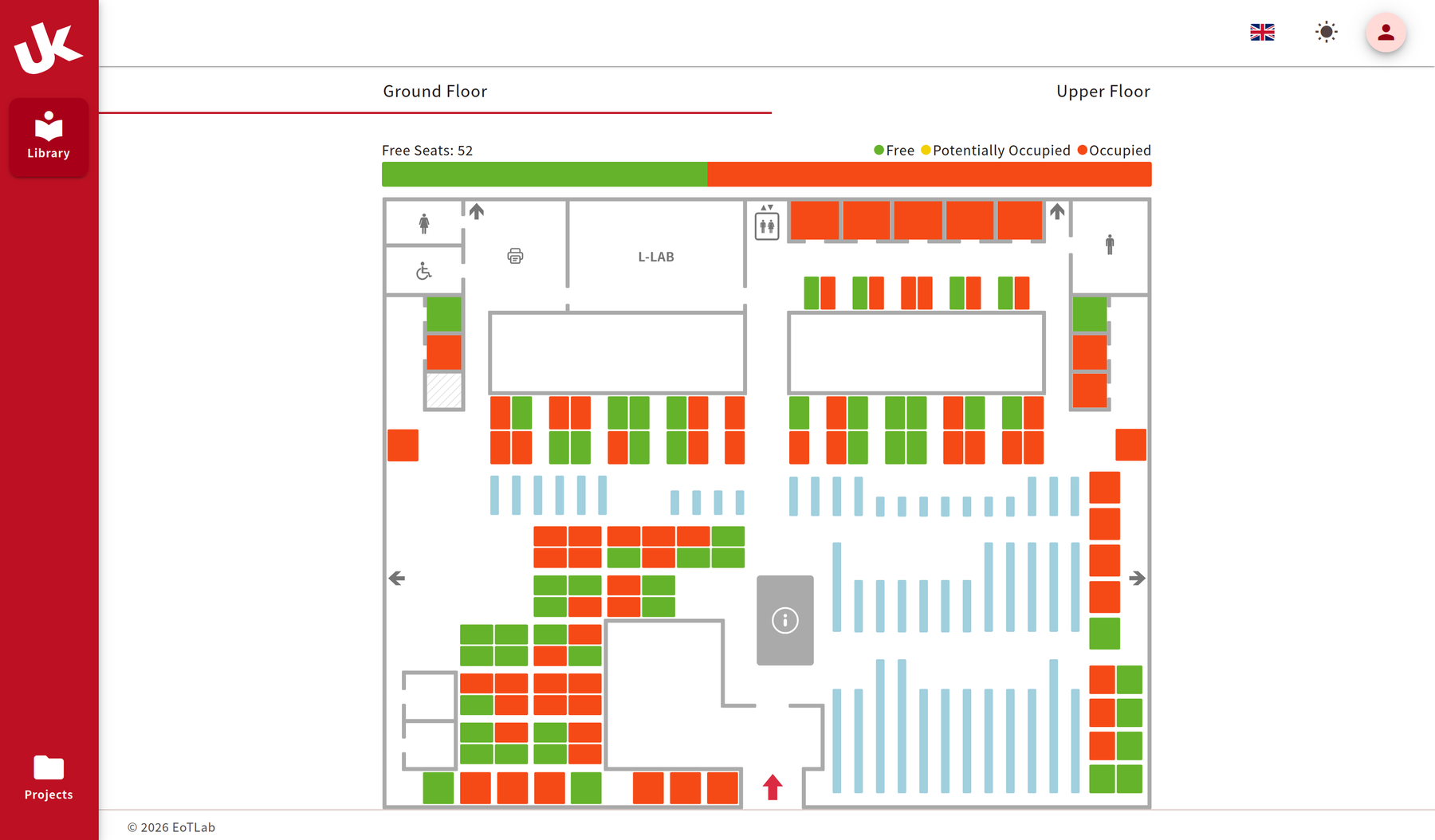
Launch of the Library Dashboard
As part of the final milestone of the federal research project EG-DAS (Entwicklung von Geschäftsmodellen für nachhaltige Datentreuhandplattformen mit offenen Architekturen und Schnittstellen), which wrapped up its successful runtime at the University of Koblenz, our team has integrated advanced data trust functionalities directly into the campus infrastructure.
From a Simple Dashboard to a Secure Data Trust Prototype
As an extension to the Smart Campus, we equipped seats in the campus library with IoT sensors that track their active occupancy. This way, students and visitors to the library are able to find free seats in real time through the Library Dashboard.
Additionally, to demonstrate the practical application of our research on secure multi-organizational data sharing, our group utilized the campus Library Dashboard as a core technical demonstrator. We successfully transformed this interface into a fully functional, secure, and multi-tenant data platform.
By leveraging the dashboard, we provided a live showcase of how organizations can seamlessly share and manage IoT sensor data while retaining absolute data sovereignty.
Behind the Tech Stack
The architecture behind the updated dashboard relies on a modern, service-oriented ecosystem designed within our university's EoTLab infrastructure:
- Frontend Integration: Built with Angular, providing a responsive and role-based user interface that dynamically adapts based on a user's explicit permissions.
- Identity & Access Management (IAM): Powered by Keycloak to enforce secure Single Sign-On (SSO) and token-based role deployment.
- Data Layer & Standards: Uses the OGC-compliant FROST-Server implementing the SensorThings API to ingest and isolate real-time library environment and sensor metrics safely on a project-by-project level.
Why This Matters
This prototype proves that data trust frameworks are not just theoretical concepts. By isolating projects natively within the dashboard, authorized users can actively toggle visibility metrics between public and private settings. This ensures strict compliance with frameworks like the GDPR and Data Act.
The results of this implementation were officially presented during the digital EG-DAS final workshop and will serve as the technical foundation for upcoming smart city and smart campus transfer projects.