
Paper Presented at ER 2024 in Pittsburgh, USA
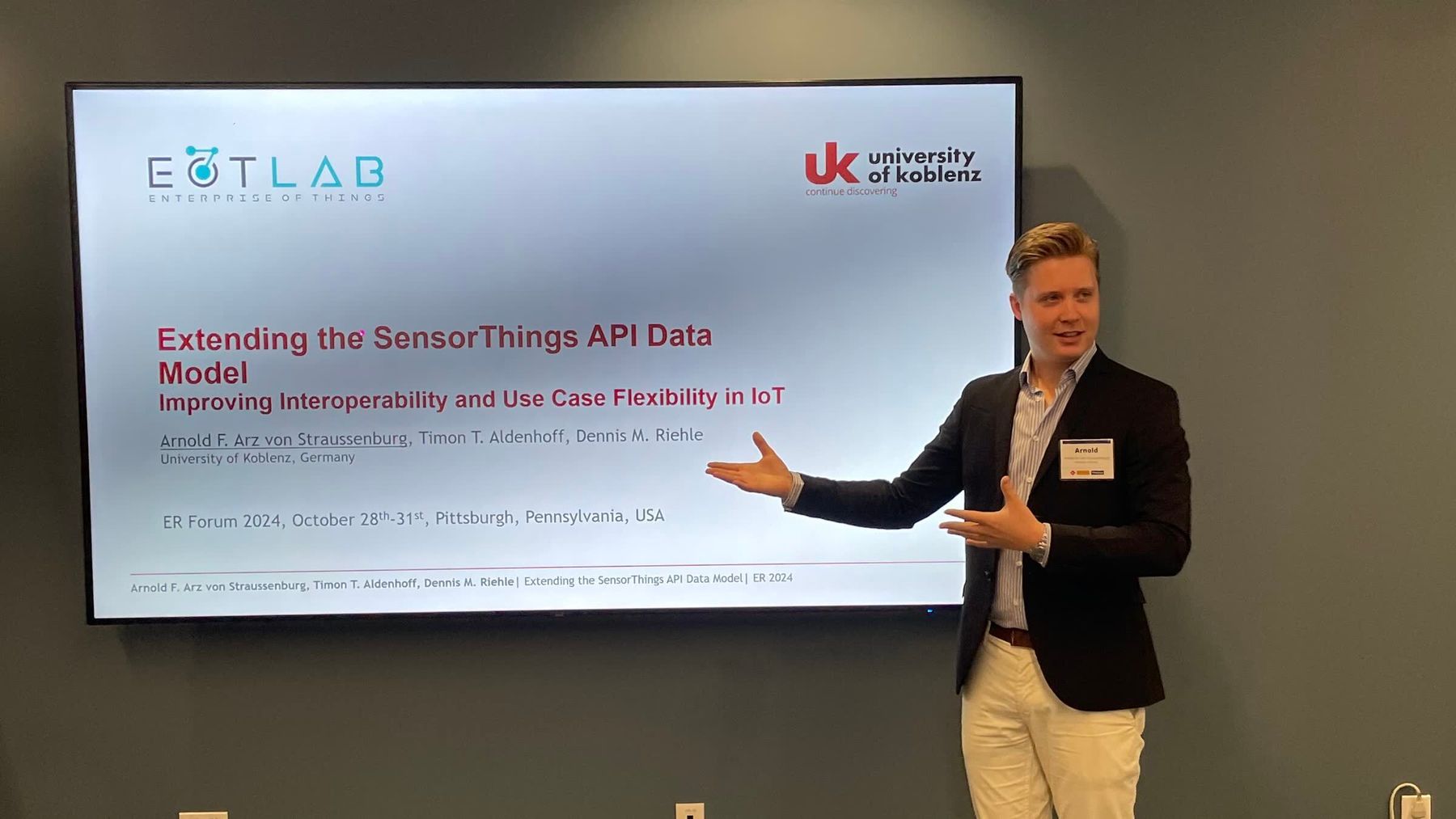
Our research group presented a paper at the ER Forum of the 43rd International Conference on Conceptual Modeling (ER 2024) in Pittsburgh, USA. Arnold F. Arz von Straussenburg presented the paper, which introduces an extension of the OGC SensorThings API Data Model that improves interoperability and flexibility for complex Internet-of-Things applications.
ER - International Conference on Conceptual Modeling
ER is a leading international forum for discussing the state of the art, emerging issues and future challenges in conceptual modeling. The 43rd edition was hosted by Carnegie Mellon University's Software Engineering Institute in Pittsburgh, USA, from October 28 to 31, 2024. Our paper was presented as part of the ER Forum session on IoT and genomics.
A Rich Conference Experience in Pittsburgh
Being invited to the Software Engineering Institute at Carnegie Mellon University made the visit particularly memorable. The institute provided an inspiring setting for exchanging ideas about conceptual modeling, software engineering and interoperable data systems. The conference brought together an international community of researchers and practitioners, resulting in many valuable conversations, new contacts and perspectives that extend beyond the paper itself.
The conference dinner offered another highlight: a boat trip on Pittsburgh's rivers, with views of the city and its distinctive river landscape. The relaxed setting created an excellent opportunity to continue the day's discussions, deepen newly established contacts and reflect on the diverse research presented throughout the conference. We are grateful to the organizers and hosts for this welcoming and enriching experience.
Paper Abstract
Extending the SensorThings API Data Model – Improving Interoperability and Use Case Flexibility in IoT
Authors: Arnold F. Arz von Straussenburg, Timon T. Aldenhoff & Dennis M. Riehle
This study presents an enhancement to the OGC SensorThings API Data Model tailored for Internet of Things (IoT) environments and demonstrates it through an extended Smart Farming application. The designed data model addresses critical challenges encountered in real-world and industrial environments while following the FAIR principles of Findability, Accessibility, Interoperability and Reusability.
The resulting architecture shows how modular components can improve adaptability and extensibility through standardization and interoperability. Decoupling modules such as device management from data storage supports consistent data handling as well as the integration and maintenance of diverse, evolving applications. An iterative development and evaluation process demonstrates the solution's effectiveness in managing IoT environments in practice. Beyond the crop-monitoring use case, the proposed models provide design guidance for standardized yet flexible IoT data management in other domains.
Funding and Acknowledgements
This research was supported by the German Research Foundation (DFG) under research grant 432399058 through the SPARCI research infrastructure. Further support was provided by the Federal Ministry of Education and Research (BMBF), Germany, under research grant 16DTM218 for the EG-DAS project as part of the European Union's NextGenerationEU program.
The discussions at ER 2024 provided helpful impulses for the further development of the data model and reinforced the importance of conceptual modeling for interoperable IoT systems. We look forward to continuing the conversations and collaborations initiated in Pittsburgh.